
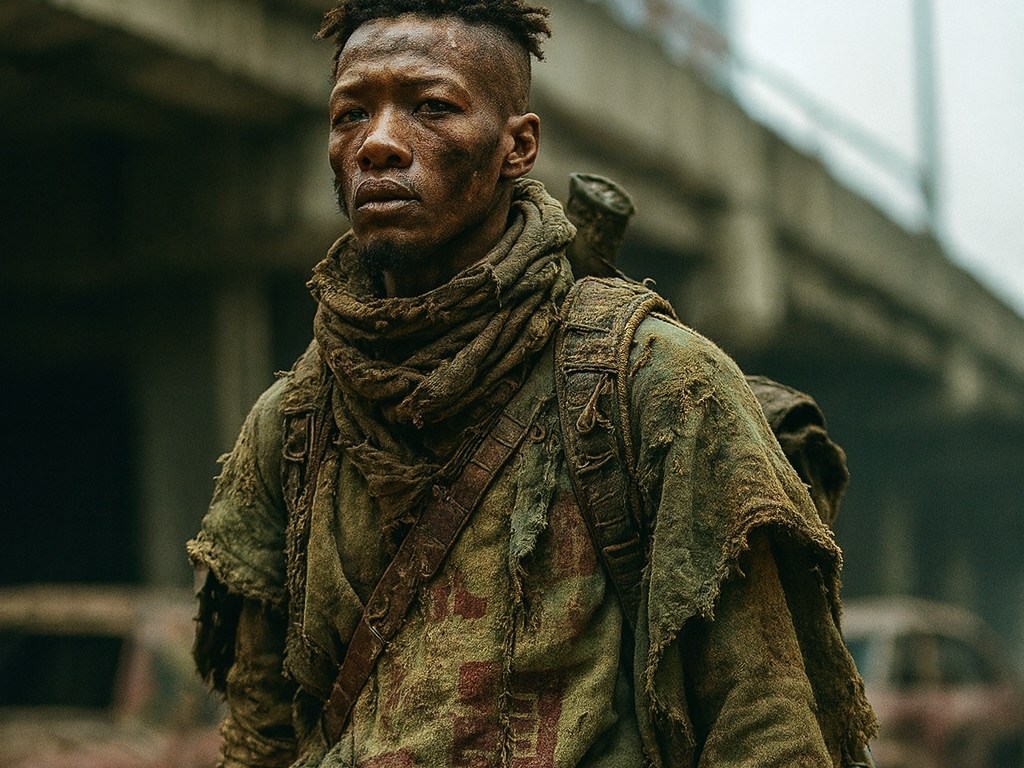
The world ended quietly.
No mushroom clouds. No alien invasions. Just a slow unraveling—systems failing, cities hollowing out, skies dimming with dust. By the time the last broadcast flickered out, seventeen-year-old Malik was already used to silence.
He’d grown up in the ruins of Atlanta, though “grown up” was generous. His mother vanished during the first wave of evacuations. His father, a mechanic with hands like iron and a heart like rust, died fixing a generator for a gang that didn’t pay him back. Malik buried him beneath a collapsed billboard that once advertised hope.
Now, Malik scavenged alone.
His clothes were stitched from scraps—seatbelt webbing, denim, canvas from old tents. A scarf wrapped around his neck to block the ash. Chains hung from his belt, not for fashion but for sound—he liked to hear himself coming. It reminded him he was still real.
He carried a backpack filled with batteries, wire, and a half-broken radio he couldn’t fix. Not yet.
The Turning Point
One day, while searching an overpass choked with rusted cars, Malik found a girl—barely breathing, curled in the backseat of a sedan. Her name was Zuri. She had burns on her arms and a voice like cracked glass. She’d escaped a firebombed settlement two miles east.
Malik didn’t know how to help people. But he knew how to survive. He gave her water, tore his scarf into bandages, and stayed.
Days turned into weeks. Zuri taught him how to read maps. Malik taught her how to hotwire solar panels. Together, they rebuilt the radio. Static turned to whispers. Whispers turned to coordinates.
There was a signal. A place called Haven.
The Journey
The road to Haven was brutal. They crossed skeletal bridges, dodged raiders with bone-painted faces, and slept in the shells of old diners. Malik learned to lead—not just with fists, but with decisions. He stopped chasing ghosts and started building futures.
He found an old journal in a library, its pages filled with poems and sketches. He began to write. Not about the world as it was, but as it could be. Zuri called it “echoes of before.” Malik called it “proof.”
Arrival
Haven wasn’t paradise. It was a bunker with solar panels and a garden growing in bathtubs. But it was safe. And it had people. Real people. Malik didn’t trust them at first. But he stayed. He helped reinforce the walls. He taught kids how to scavenge smart. He read his poems aloud at night.
One day, he stood on the roof, looking out at the broken skyline. His chains rattled in the wind. He didn’t feel like a ghost anymore.
He felt like a beginning.

 @pencilmagmen